
ABOUT THE AUTHOR

Computer vision in racquet sports enables accurate performance analytics and pose estimation. It opens new sports opportunities and boosts rapid development through data-driven training plans and smart trauma prevention, which is especially valuable due to the industry's popularity.
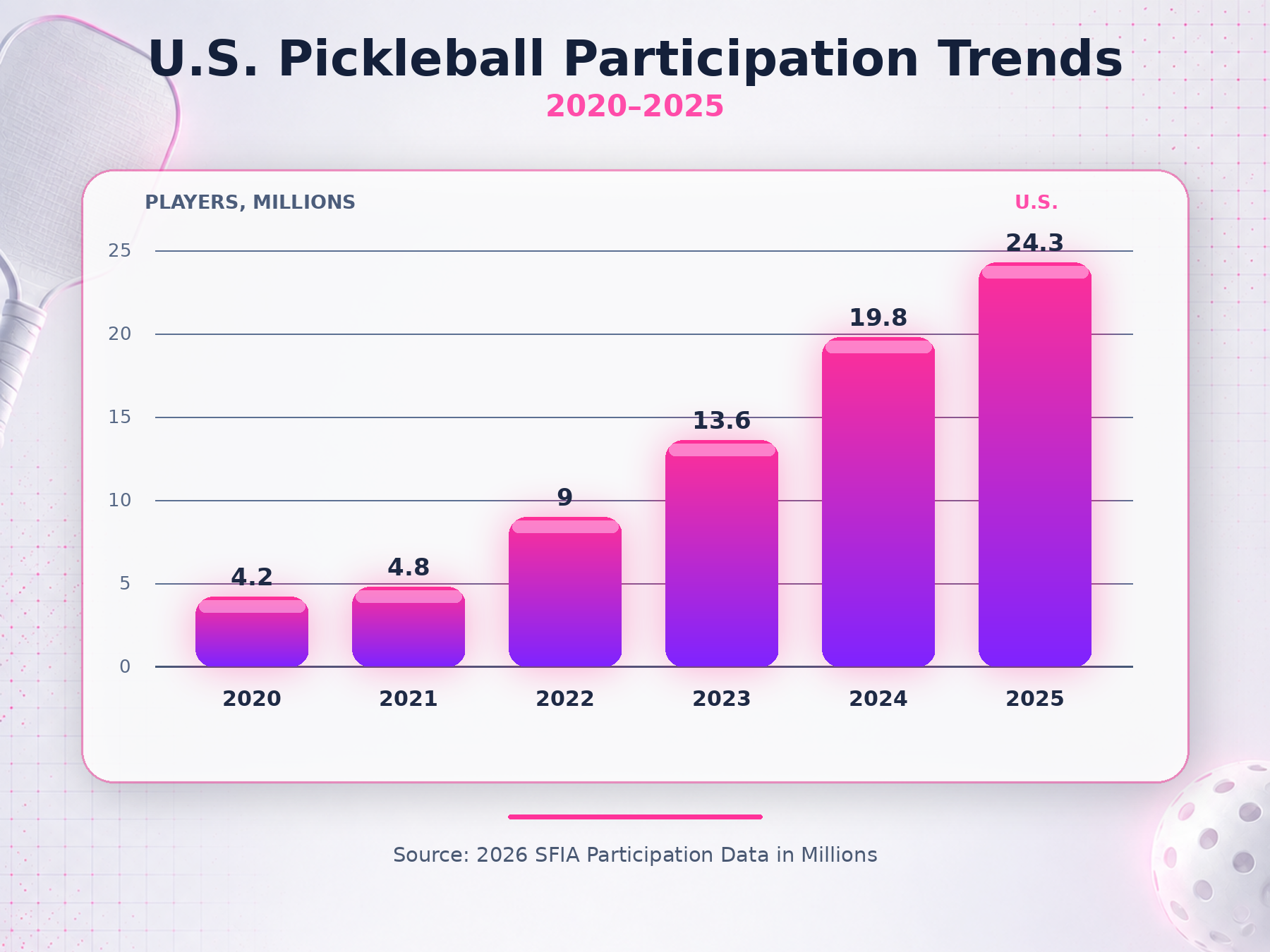
For instance, according to the SFIA reports, pickleball shows the fastest growth, reaching 24.3 million players in 2025, which is 479% more participants over 5 years. Padel is stepping into the global arena with over 58,300 courts worldwide and over 1 million players in the USA. Tennis, meanwhile, is the baseline with stable growth and sustained popularity, reaching 27.3 million participants in the USA.
CV in sports training and performance improvement empowers professional athletes and amateurs with visual data on each stage of their sporting activities.
In this article, we will share professional insight into computer vision within the racquet sports segment and its main applications. Our team explains CV’s meaning for the sports industry and the main tasks it performs, supporting our guide with a simple explanation of how the technology works in modern apps and which models are available. Here, you can also find more information about challenges for implementation and the difference between custom and off-the-shelf CV development.
What is computer vision in racquet sports?
CV in racquet sports is the use of artificial intelligence for accurate video analysis. For instance, it can automatically detect players, court lines, movement patterns, and match events. CV enables the transformation of a raw video into structured data that includes insights for coaches, generated statistics, and player analytics. As a bonus, there is no need for attached sensors.
How a racquet sports CV differs from a broadcast sports CV
Although you may consider racquet sports part of the broader category of sports analytics, they require different types of computer vision tasks, being more than just a simple subset of general sports CV.
For instance, racquet sports have relatively small and highly structured courts, unlike football or baseball. Sports like soccer also require multiple synchronized cameras for field and all players' analyses. Tennis, padel, and pickleball operate within compact areas and have a smaller number of participants.
Racquet sports follow very predictable rules and events. For example, a match usually consists of repeated ball exchanges. Court positions are constrained, and shot outcomes are easier to model. Such predictability allows artificial intelligence to analyze events and reconstruct gameplay with higher accuracy than in team sports.
In racquet sports, thanks to the small number of players and compact courts, sports events can be analyzed with the help of usual smartphone-grade cameras. A modern CV can easily extract useful data from a single device.
A traditional broadcast CV requires multiple cameras for proper analysis, and its infrastructure is rather expensive, while a racquet sports CV can dramatically lower deployment costs.
Why racquet sports CV is booming right now
Modern deep learning offers high-quality object detection, pose estimation, and improved ball tracking accuracy. Smartphones can provide high-resolution video and powerful on-device processing capabilities. As a result, athletes who take part in sports like pickleball and padel can access performance analytics, no matter whether they are professionals or not.
Computer vision in racquet sports stimulates athletes' development and enables result improvements for more affordable costs with fewer requirements for additional equipment. Recreational players can expect data-driven coaching and match insights similar to those available in elite sports clubs.
Cloud infrastructure and artificial intelligence have significantly reduced the costs of video processing, and companies can deliver automated analytics and performance feedback to millions of players with the help of a phone camera.
See which computer vision companies are leading the market
Core Tasks of Racquet Sports Computer Vision
The core computer vision tasks in racquet sports cover many aspects, like court detection, shot recognition, pose estimation, and some more. Let’s see how it transforms raw match video into a source of valuable insights and structured analytics.
Computer vision court detection, and calibration
Before analyzing player movement or ball trajectories, the system needs to understand the area where the action takes place. This is what makes court detection one of the most important aspects for any racquet sports CV pipeline.
Convolutional neural networks (CNNs) and keypoint detection models enable accurate identification of court territory, including baselines, markings, and corners. Once the keypoints are detected, the computer vision court detection system analyzes the placement of objects in the area. The camera calibration process helps establish the relationship between image coordinates and real-world coordinates, enabling more accurate measurements. Systems can apply the pinhole camera model to computer transformations and camera parameters. As a result, video observations can be mapped onto the court model.
In our project for automatic tennis game statistics, we also applied a CNN-based court recognition to reach efficient camera calibration and precise detection of players' positions on the court. It enables proper re-identification of players and their tracking during the entire game. Thanks to this, coaches can analyze statistics of shot positions, successful shots, and the number of errors. The statistics of movements on the court allow athletes to create better strategies.
Computer vision player tracking after detection
The system identifies athletes in each frame and ensures they remain identified during the whole process. Modern implementations usually utilize detectors such as YOLO and RF-DETR for high-accuracy player location during real-time performance.
SORT and DeepSORT algorithms, thanks to their ability to track multiple objects simultaneously, associate detections between frames, and efficiently generate continuous movement trajectories. Computer vision player tracking algorithms work perfectly when it comes to movement analysis and tactical insights from positioning metrics.
Double matches add complexity because players can overlap or cross paths. Re-ID (re-identification models) ensures stable identifications by learning what players look like. They analyze body shapes, clothes patterns, and colors.
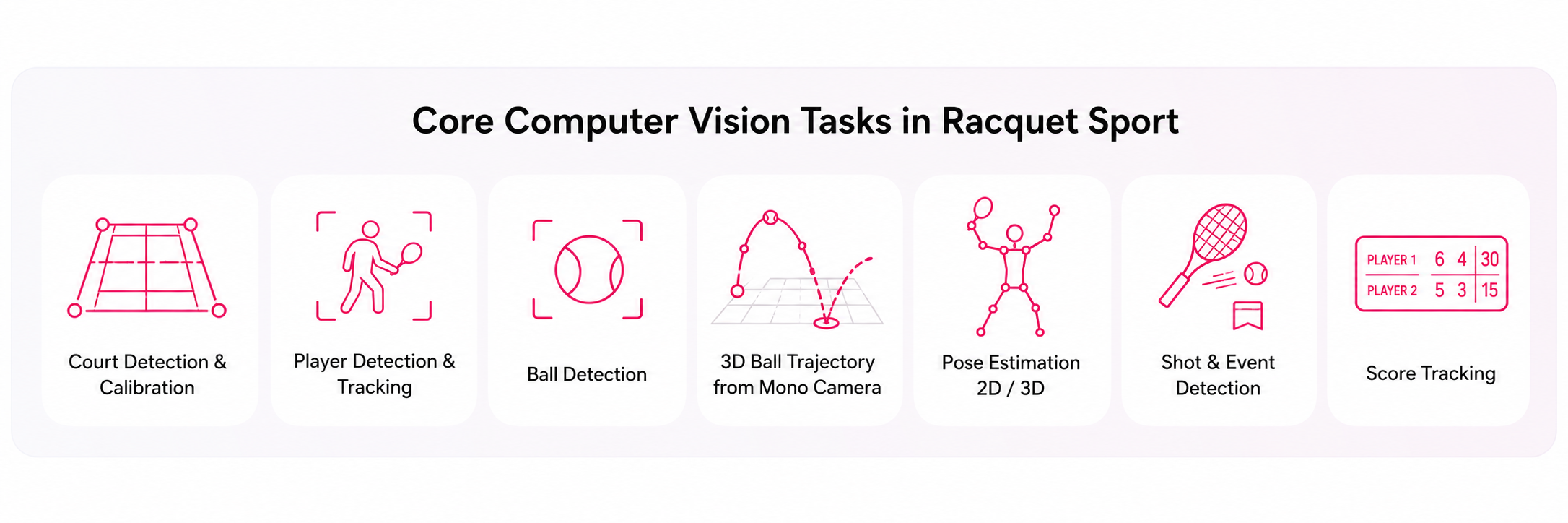
Computer vision ball tracking
Ball detection is one of the most difficult CV tasks, as a ball usually needs only a few pixels in broadcast videos and may cause significant motion blur because of its speed. Traditional object detectors are used to analyze frames independently and frequently struggle to detect such a small object.
To address this problem in our project with tennis serve analysis, we developed a custom 3D-CNN model, empowered by TensorFlow. The main advantage of this computer vision ball tracking tool is its ability to extract information across multiple frames. A 3D-CNN model architecture allows identifying even partially blurred balls, which are difficult to distinguish from the background. Our custom virtual assistant can compare users' and balls’ movements with references and identify where the technique has an error. As a result, players can get deeper insight into their performance and develop better technique for further personal sporting development.
The accuracy of CV ball tracking heavily depends on camera quality, environmental conditions, and frame rate. Installation position can also have an impact. In controlled environments, tracking systems can achieve higher precision and accuracy, but in real-world situations, accuracy depends on many factors. They include occlusions, reflections, deployment constraints, and changes in lighting. We consider all these aspects when creating high-quality computer vision systems for tracking pickleball, tennis, and other racquet sports.
3D ball trajectory reconstruction with a mono camera
Once ball-tracking computer vision is applied, the next step is to reconstruct the motion in three-dimensional space. Usually, professional systems work with several synchronized cameras. Modern CV techniques allow the estimation of 3D trajectories with a single camera view.
The trajectory reconstruction combines physics-based constraints, temporal ball observation, and court geometry to estimate depth, speed, angle, and, finally, trajectory shape. Gravity and ball dynamics should also be taken into consideration to get accurate performance metrics. As a result, you can get clear information about ball speed, bounce points, and landing positions.
2D and 3D pose estimation computer vision
Pose estimation depends on understanding the player’s biomechanics through anatomical keypoints, including shoulders, elbows, hips, etc. Frameworks like MMPose, MediaPipe, and OpenPose offer accurate 2D models made from the provided video.
Advanced pipelines can extend it into 3D pose representation and provide more detailed biomechanical analysis of movements. For instance, we achieved such 3D pose estimation with the help of MMpose and custom TFLite in our tennis serve analysis project.
Pose estimation computer vision is a valuable source of data related to an athlete’s technique, movement efficiency, and body coordination. By estimating the pose, sportsmen can get timely information about injury risk factors and avoid potential harm in time. Coaches and analysts can apply received insights to evaluate serving mechanics and overall athletic performance.
Shot and event detection
Beyond object and pose detection, sports analytics systems need to understand what actions and events take place during a match. For instance, event tracking and computer vision shot detection enable recognizing various activities from video. Temporal action recognition models like 3D-CNNs and transformer architectures like TimeSformer analyze actions across multiple frames and classify events.
These models usually receive information from ball trajectories, body poses, and player movements to improve classification accuracy further. With automated event recognition, analysts can offer better match annotations and effective tactical breakdowns. There is also no need for manual work when it comes to searchable video highlights.
Score tracking
The final stage is to convert all detected events into structured match information. Modern systems often have a hybrid architecture that consists of the computer vision outputs and a rule-based scoring engine. It means that computer vision elements detect serves, bounces, faults, and a lot of other events. As a result, analysts have automated score-tracking systems that remain consistent with official rules.
How does a racquet sports CV app actually work?
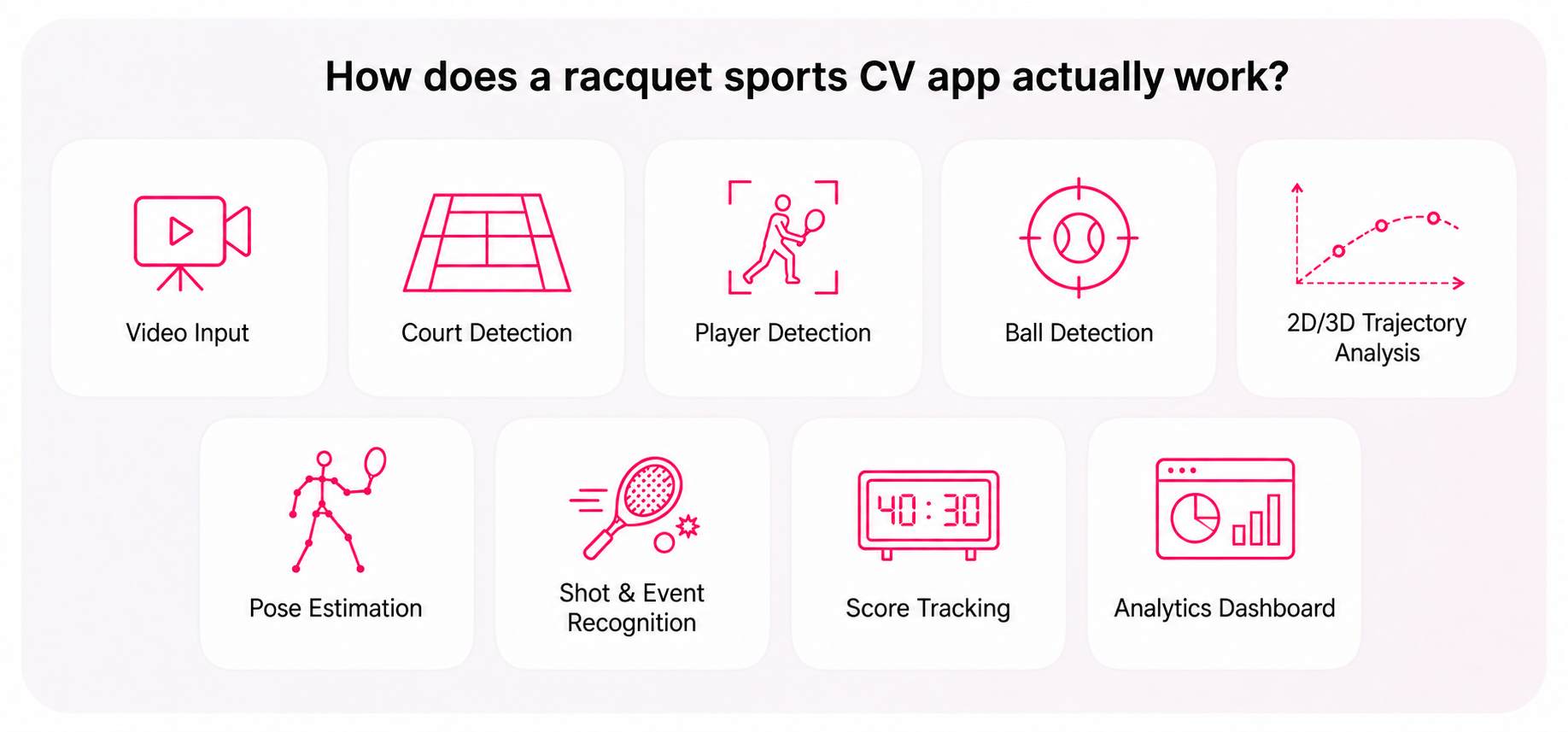
Computer vision in racquet sports applications transforms match videos into structured analytics data received from court detection, player and ball tracking, and various movement estimations. Basically, it helps recognize shots and other match events and applies scoring rules to them to get accurate real-time and post-match insights.
End-to-end pipeline
Basically, CV’s functionality in racquet sports applications is the process from video capturing to showing analyzed data on the dashboard. Video input is processed by computer vision step by step.
At first, it goes through detection stages where the system learns what each object on the court looks like and what to expect from it. Then, CV analyzes trajectories and poses for a better understanding of the applied action. After this, the video is processed by tools for shot and event recognition and score tracking. As a result, the app’s user can see the analysis of the entire video, provided at the beginning.
Real-time vs offline trade-offs
Real-time systems are designed with a focus on immediate feedback, which is especially valuable for coaching and live statistics. It means they work during video broadcasting, collecting video input, and processing it through computer vision to analyze and visualize data simultaneously.
Offline trade-offs are designed to provide deeper and more detailed analysis. A computer vision system processed previously recorded videos with higher accuracy and can offer larger amounts of data. For offline trade-offs, developers usually use large AI models and multi-pass processing.
Single vs multi-camera trade-offs
Naturally, single-camera setups are less expensive and easier to deploy. This option works well on racquet sports courts, and it is perfectly suitable for their analysis. But keep in mind that depth estimation and occlusion are more difficult to handle when you have only one camera.
The multi-camera approach is expensive, but it provides better 3D reconstruction and higher trajectory accuracy. Several points of view make player and object tracking also easier and more productive. But the deployment is more complex and requires robust hardware; synchronization between cameras is also a must-have to deliver accurate statistics.
Cloud vs edge
Cloud-built systems offer more scalable compute resources and centralized model management. The cloud is vital for large-scale analytics platforms and those who need really powerful processing capabilities.
Edge deployment is more flexible and can perform directly on smartphones or court-side hardware. This choice is good for locations without a stable internet connection and, as a valuable bonus, can improve privacy.
Inference frameworks
The iOS platform works well with Core ML, while for Android devices, we would recommend TensorFlow Lite, as it broadens hardware support. Cross-platform applications are often designed on ONNX Runtime, while NVIDIA-based solutions can gain better performance with TensorRT. As a framework for cloud deployments, we would concentrate on models with TensorFlow and PyTorch.
Case Study: A Mobile App for an Australian Rugby Club

Computer Vision Across Racquet Sports
Computer vision can be applied to all racquet sports, but the technical challenges it faces may vary dramatically depending on court shape, ball speed, game rules, and a lot of other factors. Some sports have various commercial solutions, while others can offer only more opportunities for customer computer development.
Computer vision tennis
CV for tennis is the most mature and well-developed. Standardized court dimensions and decades of tracking data enable the creation of robust solutions for ball tracking, match analytics, and pose estimation. Computer vision swing analysis is also a technology that can improve the understanding of actions on the field, thanks to AI-powered algorithms. They can automatically detect, track, and evaluate a player’s stroke mechanics from video footage.
Requestum has created two solutions for this absolutely traditional racquet sport: one for computer vision serve analysis and another for automatic tennis game statistics.
Our tennis computer vision solutions extend coaching capabilities with accurate 3D pose estimations and ball detection. Game statistics can measure the number and types of shots made by players and analyze the number of errors during games and training. We have created a statistical system for movements, positions, and shots to help players develop their skills.
Computer vision pickleball
The quick development and growing popularity of this sport create a strong demand for automated analytics solutions and tools for training and coaching. But sports specifics add their challenges, like the presence of a non-valley zone, also known as the kitchen, with its rule-based event detection requirements. The system needs to analyze not only the usual player and ball locations but also control whether actions take place in restricted court zones.
Double plays add an extra level of complexity because four players can more frequently overlap, creating occlusions that make computer vision pose estimation and ball tracking challenging tasks.
When we were working on our AI-powered pickleball game statistics solution, we also faced all these challenges and used CNN-based court recognition to improve camera calibration. The application provides statistics on movement on the court and keeps track of shots, their types, successful tries, and errors. Applying pickleball computer vision, we achieved accurate player re-identification and tracking during the entire day.
Computer vision padel
We consider padel the source of opportunities for CV systems, as this sport is significantly lacking in a variety of applications for statistics and monitoring compared to good old tennis. The greatest difference and challenge is created by glass walls. Unlike tennis or pickleball, according to the rules, the ball can actually rebound off walls.
Computer vision tennis solutions will not help here, as models need to understand interactions not only between the ball, players, and court but also reflective surfaces. Ball-off-wall events can cause errors for standard racquet sports tracking models, as reflections from glass can trigger false detections. Also, the enclosed courts seriously limit possible positions and locations for the camera.
Computer vision table tennis
Table tennis is a serious challenge for CV due to its extreme speed and acceleration. For instance, shots can exceed 90 mph with the ball diameter of only 40 mm. It means that catching the ball between frames and providing reliable detection is an absolutely new level of complexity. To match the demand, table tennis CV systems require cameras capable of 240 fps or higher. High-speed capture leads to higher hardware costs and storage requirements.
Computer vision badminton
Badminton, meanwhile, provides absolutely new challenges thanks to the unique aerodynamic drag of a shuttlecock. Its flight paths are non-linear and hard to predict, so trajectory-based computer vision for tennis or paddle solutions will not help there, as they assume more predictable motion. Shuttlecocks can accelerate and change directions more dramatically than balls in any of the racquet sports. It means that badminton requires very specific motion models rather than usual object-tracking apps.
Squash and racquetball
Squash and racquetball share a lot of elements with padel, but provide even more constraints for visibility. For instance, the action takes place on enclosed courts, where the walls are involved during the match. The ball can change direction after rebounds, creating completely different trajectories that add complexity and reduce the effectiveness of standard tracking solutions.
Players often stand between the cameras and the ball, so limited camera placement options make coverage even more difficult than in open courts.
Which sport is the hardest CV problem?
Based on our experience, there is no single answer to this question, because complexity depends on the aspect that you need to measure. For instance, if we are talking about speed, table tennis is the hardest, but if we think about physics modeling, then badminton takes the first place. Padel, squash, and racquetball represent the highest environmental complexity, while pickleball adds challenges with its rule-aware analytics. Whatever hard tasks your sports have, our experts are ready to face the challenges and create a custom solution that will be effective and tailored to your tasks.
| Sport | Court | Ball speed | Players | CV difficulty | Products |
|---|---|---|---|---|---|
| Tennis | Open | High | 2-4 | Medium | Tennis serve analysis, Automatic tennis game statistics |
| Pickleball | Open | Medium | 2-4 | Medium | AI-powered pickleball game statistics |
| Padel | Glass walls | High | 4 | High | PlaySight |
| Table Tennis | Table | Extra High | 2-4 | Very High | TrackNet, some specialized systems |
| Badminton | Open | Extra High | 2-4 | Very High | TrackNet |
| Squash | Enclosed | High | 2 | High | TrackNet |
| Racquetball | Enclosed | Very High | 2-4 | High | No official apps |
Technologies and Models of Computer Vision in Racquet Sports
Based on our experience of working with CV for racquet sports applications, we have prepared a short guide on the most useful models and technologies.
Object detection
YOLOv8 and YOLOv9 are very good options when it comes to real-time player detection, thanks to their strong speed-accuracy tradeoff. For ball tracking, we would recommend custom small-object detection approaches, as balls take only a tiny part of the frame and move at a high speed. Also, RF-DETR can serve as a modern alternative, which can improve robustness under challenging circumstances, such as in crowded areas or unclear visual conditions.
Pose estimation
For pose estimation computer vision, we would recommend using MMPose, as its pose estimation models work perfectly in research environments. Also, Media Pipe is a lightweight and mobile-friendly solution that you can use in real-time applications. OpenPOse is a good choice of legacy framework, while custom TFLite models serve pretty well when 30+ fps is critical for your device performance.
Tracking and re-identification
SORT, DeepSORT, and BoT-SORT are the tracking frameworks that can combine object detection with a motion model. But when it comes to double matches, we recommend using custom re-identification embeddings to maintain players’ identity across the entire match.
Action recognition
Modern systems utilize 3D convolutional neural networks, such as I3D, X3D, and SlowFast, to recognize movement patterns and tactical behaviors directly from videos. If you need to handle longer action sequences, we recommend TimeSformer for powerful temporal modeling. Also, for racket sports computer vision, our experts find vision-language models (VLMs) especially useful, thanks to their ability to combine detection and interpretation.
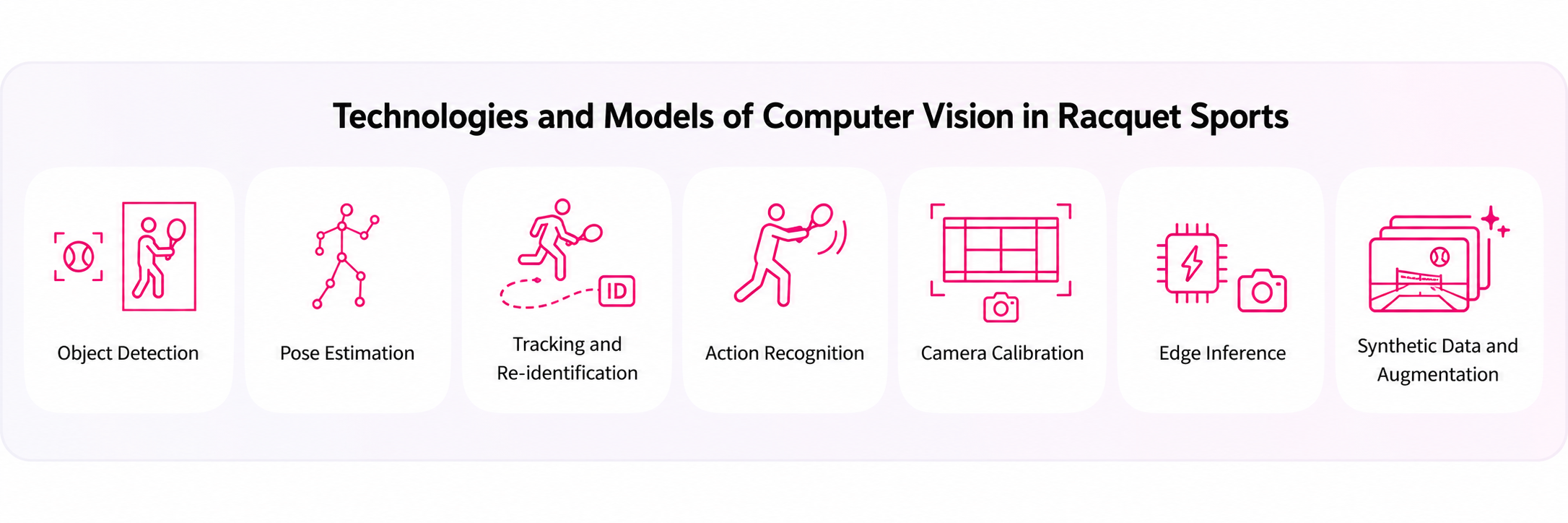
Camera calibration
For camera parameter estimation and players' positions in real-world coordinates, we often use pinhole camera models and OpenCV calibration utilities. Also, CNN-based court keypoint detection is a time-saving solution to automate the identification of court lines and reference points. These techniques help improve player positioning metrics, movement analysis, and tactical visualization.
Edge inference
Core ML can enable efficient deployment on iOS devices, while TensorFlow Lite is a perfect solution for Android platforms. For cross-platform model operation, we can also recommend ONNX Runtime. When it comes to inference performance optimization for NVIDIA GPUs for large-scale analytics pipelines, TensorRT is quite a popular solution.
Synthetic data and augmentation
Unreal Engine-based court simulators create realistic virtual environments where cameras, players, and balls are simulated automatically. With 3D-rendered player models, coaches and athletes can see the generated digital athletes in various poses and movements to develop and create training programs without the need to film real people.
Domain randomization enables simulation under various environmental conditions, like different lighting, camera angles, or backgrounds. It teaches models how to handle diverse real-world conditions and provide more accurate analysis.
With data augmentation, we can modify existing video and image materials to create additional training samples. As a result, when labeled racquet footage is scarce, these techniques help build large training datasets to cover the lack of manually-created materials.
Engineering Challenges in Racquet Sports CV
Our expert team has been working with computer vision for years, and, knowing all the pitfalls, we want to share the challenges we have faced on our development road.
Ball detection at high speed
One of the hardest problems in racquet sports analytics is ball detection at high speed. For instance, tennis, padel, and pickleball balls can move bunches of pixels between frames, creating significant motion blur. This issue is especially painful for computer vision pickleball applications, where direction changes can quickly disturb the work of tracking pipelines. During development, it was obvious that the frame-by-frame object detection is inefficient for stable tracking, so we combined detection models and tracking algorithms to maintain continuity.
Doubles occlusion
Player occlusion is one of the common sources of tracking errors in double matches, as players and court elements often get in the way. This often leads to fragmented trajectories and inaccurate event detection. To address this issue, we implemented predictive tracking models that can estimate the ball’s likely position when it is not seen. These techniques really helped improve trajectory continuity and reduce tracking failures.
Padel glass walls
Glass wall interactions are a unique challenge in this racquet sport, as the ball rebounds off a transparent surface, adding reflections that can be wrongly considered as real objects. Building a robust computer vision padel system requires a specialized dataset that could contain wall interactions, reflection examples, and complex bounce sequences.
Variable camera setup
Standardized camera setups don’t work really efficiently in real-world deployments. Different situations may require various mounting heights or focal lengths, and you need to choose the correct resolution and viewing angles. Models trained only on one environment fail when they need to be applied elsewhere. To improve generalization, we train our models across diverse court configurations and implement geometric normalization techniques so the camera is not so dependent on a specific perspective.
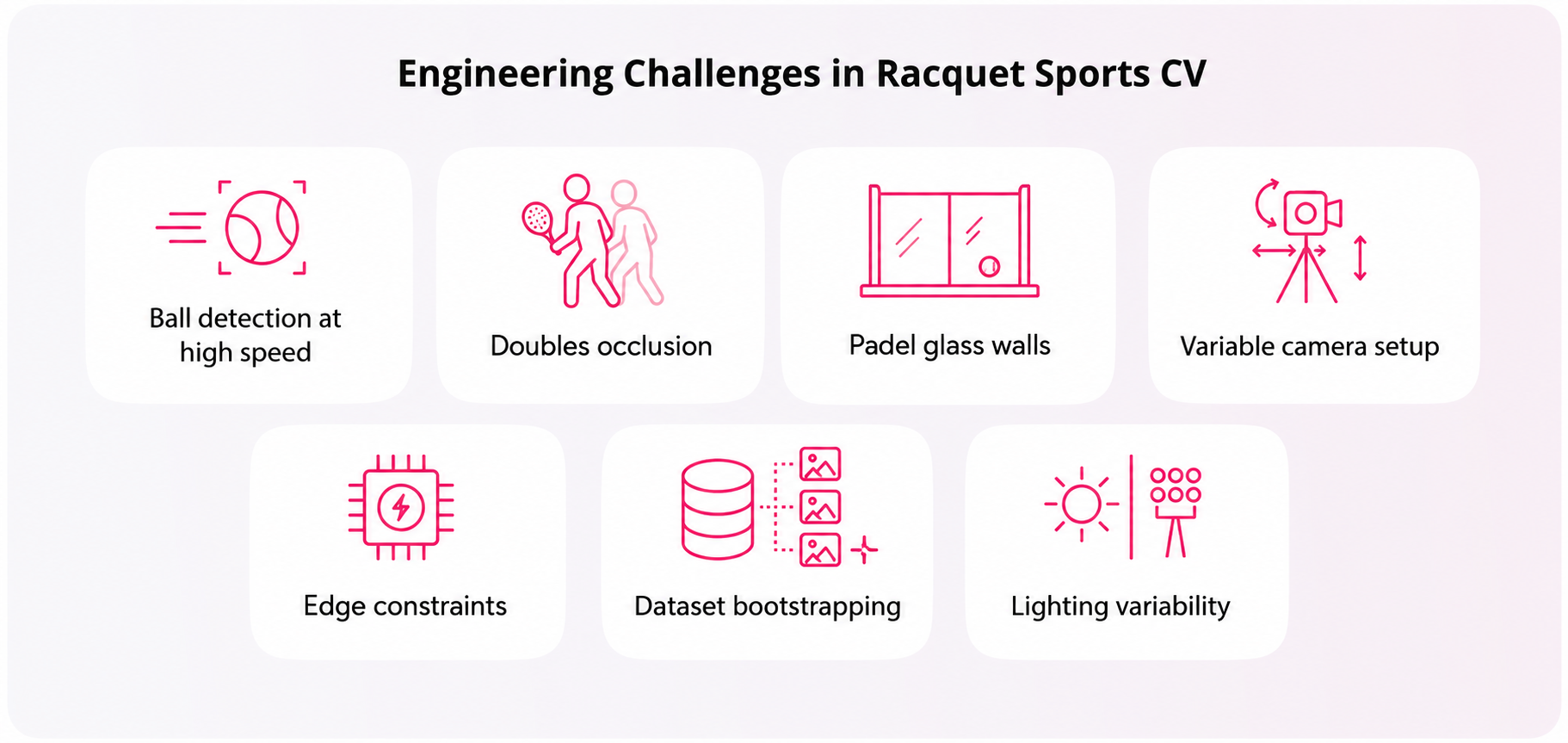
Edge constraints
Many analytics systems require the operation directly on edge hardware rather than cloud infrastructure. It creates strict constraints on model size and inference latency. To deal with this problem, we optimize deployment pipelines with model compression and lightweight tracking architectures.
Dataset bootstrapping
Large and accurately labeled sports datasets are quite expensive and time-consuming, and manual annotation of ball trajectories needs frame-level precision and a lot of effort. So, we used transfer learning from existing object detection datasets and implemented training with synthetic data generation. As a result, we get reliable models ready to work even before enough sports-specific footage has been collected.
Lighting variability
Changing lighting conditions is another one of the most widely spread operational challenges, as outdoor courts experience a lot of changes due to sunlight, shadows, clouds, or seasonal effects. Domain adaptation techniques and data augmentation can help to deal with this issue, and we also train our models to react under different light conditions to maintain the high-quality analysis no matter what.
Who Uses Computer Vision in Racquet Sports?
Based on our experience and personal observations of CV use, we believe the following categories of users will benefit most from CV-powered apps.
-
Consumer app for amateur players: CV makes advanced technology available for non-professional players, empowering them with high-quality statistics and the opportunity to improve results.
-
Coaching platforms: Coaches can use CV technology to monitor training, get valuable insights, and direct athletes’ development effectively and safely.
-
Club and facility installations: The club can develop its own software to open more opportunities for its athletes and make the CV technology available for all members.
-
Tournament and broadcast tech: A CV in combination with generative AI can create various analytics and assist during broadcasting and tournament handling in real-time.
-
Pro tour analytics: Professional analytics can apply computer vision to study athletes' actions at every part of the match and offer highly accurate insights.
Let’s build a solution tailored to your needs
Custom Computer Vision Development vs. Off-the-Shelf: Which to choose?
This is one of the most common questions when it comes to new app development, so let’s review when an off-the-shelf option is enough and when custom is your best choice.
When to choose an off-the-shelf CV
The first reason to consider off-the-shelf software is the cheaper development process, but in some cases, the ready-made solutions can be quite handy. For instance, if you want to apply it for a single sport, such as tennis, and you don’t need your app to adapt to different sports circumstances, an off-the-shelf solution can help. It is also suitable when you require standard metrics, like speed or shot count. As a pre-adjusted unit, the model has a fast time-to-market, and all the IP rights belong to its creator.
When you need custom development
Custom development is more expensive and takes a longer time-to-market, but it is more flexible for specific needs. For instance, there are not so many effective applications for padel, as it is quite a new racquet sport, so a standard off-the-shelf solution will not work equally effectively for it. Custom is a good option when you need proprietary metrics, like kitchen rule analytics, which are not available in ready-made solutions. It is suitable for on-device constraints and enables custom hardware integration.
With custom development, branding is also custom and can be fully adjusted to your club, for example, and your company has IP ownership of the model. If you have a product with specific requirements and want to make it fully tailored to your athlete's needs, custom development is the best option.
Hybrid approach
The combination of the two approaches takes some elements from both versions, making it partially universal. It offers an open-source foundation based on YOLO or MMPose and adds custom fine-tuning to make it more tailored to your needs. You can also add their custom calibration and proprietary scoring rules, which are enough for most sports tech startups.
How long to build a CV app?
There is no single strict time frame, as the development process depends on the complexity and type of project. For instance, simple solutions can take a month, while a very complex project may need a year. We provide all the time predictions during the discussion of a specific project.
| Criterion | Off-the-shelf | Custom |
|---|---|---|
| Accuracy | Limited to vendor capabilities, usually standard objects. | Often higher. Tailored to specific sports data. |
| Time-to-market | Fast deployment | Longer development + testing period before official launch. |
| Total cost of ownership | Lower initial cost, but extra costs for licensing and possible subscription. | Higher initial cost, but lower in the long-term view. |
| IP ownership | The vendor has all the rights. | You have full ownership. |
| Ability to evolve | Tied to vendor and solution features. | Fully adjustable to changing needs and scalability. |
With Requestum’s experience in custom racquet sports solution creation, we can develop an application that will fully match the needs of your athletes and club. Check our computer vision development services to see what we can offer.
Conclusion
Computer vision in racquet sports has become one of the most helpful tools for athletes’ development and analytics. The combination of structured gameplay and growing demand for performance analysis makes tennis, padel, pickleball, and other racquet sports well-suited for AI-driven technologies. Especially considering that the market continues to grow: pickleball shows fast spreading, and padel expands its reach across Europe and America. Mobile inference breaks all entry barriers, making a modern CV available without expensive hardware and broadcast-type infrastructure.
Requestum has developed expertise in tennis serve and match analytics projects as well as an iOS-based application for pickleball, featuring on-device inference. Our experts can adapt proven CV approaches to create solutions for sports such as padel by transferring learning from tennis datasets and models to make development faster and reduce initial costs.
If you are considering the creation of a computer vision product for racquet sports, Requestum can help evaluate technical parameters, architecture, and requirements for your custom solution. Contact our CV engineering team to discuss how CV can support your project goals and help gain an advantage in a fast-growing market.

Our team is dedicated to delivering high-quality services and achieving results that exceed clients' expectations. Let’s discuss how we can help your business succeed.


SHARE: