
ABOUT THE AUTHOR

A coach reviewing last night's game footage and a physical therapist tracking a patient's recovery have one thing in common: both need to understand how a human body moves. For decades, that meant manual observation, frame-by-frame review, and a lot of guesswork. Human pose estimation is what replaced it.
Human pose estimation (HPE) is a computer vision technique that automatically identifies the position of key body joints (shoulders, elbows, knees, hips) in an image or video and maps them as spatial coordinates. No wearable sensors, no specialized equipment: just a camera and a trained model.

The technology has moved well past the research lab. The sports analytics market was valued at $5.68 billion in 2025 and is projected to reach $23.15 billion by 2033 at a CAGR of 18.5% and pose estimation sits at the core of that growth. This article covers how HPE models work, the difference between 2D and 3D approaches, the libraries practitioners use, and where the technology creates measurable value today.
What Is Human Pose Estimation and Why Does It Matter?
Human pose estimation (HPE) is a technology for identifying and classifying human body parts. HPE is used to determine the coordinates of each body part (arm, head, torso), and it is called a key point. Modern HPE models have many advantages, namely:
Contactless data tracking
The main benefit of HPE technology is that no special sensors or suits are needed to recognize movements. Specialists need only a camera to identify body parts. It makes the technology convenient, accessible, and hygienic.
Real-time monitoring
One of the main goals and advantages of posture assessment is tracking parameters at the current moment. It is important in fitness, games, and the security sector. In these areas, experts should record movements immediately to take action or suggest changes in time.
High accuracy
Modern HPE models identify body parts with high precision even when a person is partially hidden, poorly lit, or facing away from the camera. The model accounts for body angle, projection, and symmetry to produce reliable joint coordinates regardless of viewing conditions.
Versatility of applications
Body poses' estimation has applications in many fields of science and everyday life:
-
Fitness and health: control of exercise technique.
-
Safety: detection of falls, fights, or suspicious behavior.
-
VR/AR (virtual/augmented reality): motion capture without equipment.
-
Medicine: analysis of movements during rehabilitation.
-
Art and animation: motion capture without sensors.
2D vs 3D human pose estimation
There are two main methods of pose estimation: 2D and 3D. These methods are equally needed for human body pose estimation.

2D pose estimation
This method of estimating body poses analyzes a video or image in only two dimensions: width and height. The 2D model sсreens a picture and finds key points of the body (wrist, knee). These points are then displayed as 2D coordinates (x, y) on the picture.
Benefits of the 2D model
- Ease of perception: The system analyzes two key axes (horizontal and vertical).
- Fast data acquisition: The 2D model assumes faster calculations and is more straightforward than the 3D model. The task of 2D systems is to identify the location of points on a flat image.
Limitations of the 2D model
- No information about the depth: The 2D model does not estimate how close or far the body's points are relative to the camera.
- Possibility of errors: When a person has turned, some points can be hidden. It happens because the model can't identify the depth of the image. For example, two people standing beside each other overlap in the photo.
3D pose estimation
In 3D human pose estimation the system estimates the body in three dimensions. This model can consider the image's width, height, and depth (distance from the camera). The 3D estimation method can determine the location of body points in the image and how these points are located in space. For example, the system can distinguish how deep or far the left hand is relative to the right hand.
Advantages of the 3D model
-
Accurate data and the analysis of the depth: Experts can use a 3D model to determine where the human body or some part of the body is in space. For example, we can understand whether the hand is in front of the body or behind it.
-
Ability to analyze complex images: The 3D system can accurately determine body parts, even if the person is turned, the lighting is poor, and the image is complex.
Limitations of the 3D model
-
Complexity of analysis: Of course, analyzing images in 3D is much more difficult than in 2D. More computing power and data are required.
-
The need for additional devices: Special cameras or sensors are used to obtain accurate 3D information. Experts should have cameras that create a 3D model of the scene or use stereo images.
Comparison of 2D and 3D
Review the main differences between these two models and then consider a visual table comparing 2D and 3D HPE parameters.
-
2D HPE: When we analyze images using 2D human body parts estimation, we consider the pose on the screen as a flat picture. We don't consider where exactly the body points are in space.
-
3D HPE: Using 3D human pose estimation, we see not only where the points are in the picture but also where these points are in space relative to the camera.
Discover how AI is changing rugby
Types of Human Pose Estimation Models
How is body pose assessed? There are three most popular types of detection models:
Skeleton-based (kinematic) model
This model displays a set of key points (joints), such as ankles, knees, and elbows. The kinematic model scans the skeletal structure of the human body. This model is often used in 2D and 3D pose estimation methods.
Contour-based model
The model consists of a contour and shows the approximate width of the torso and limbs. The boundaries demonstrate a person's body's current position and supposed shapes. The contour-based model is a great prototype for 2D body pose estimation.
Volume-based model
It is a complex 3D image of the human body and poses. The picture under number 3 shows a volumetric model with geometric grids. This type of model is best suited for 3D deep-learning-based human pose estimation.

We have discussed these three basic methods, but there is also a hybrid approach. It is a one-stage method (BlazePose, CenterPose). In this case, the body silhouette detection stage is skipped. The models regress key points from the image directly.
Methods of Human Pose Estimation
There are two main methods of human pose estimation. Bottom-up methods work better to estimate the number of people, while top-down methods are best for assessing the poses of separate people.
Bottom-up methods
This model means all key points, such as joints like elbows and knees, are in the image. The system then connects these points into skeletons of individual people using a grouping algorithm.
The bottom-up method is more suitable for analyzing many people, even a crowd. However, this method could be less effective in correctly grouping joints, especially when people overlap.
Examples of pose estimation CV models: OpenPose, PifPaf
Top-down methods
In this case, all people are found in the image, after which each person's pose is determined separately. Experts should apply detectors to use top-down methods. For example, Faster R-CNN or YOLO detectors work well to identify people.
Top-down methods of HPE are more suitable for determining individual or separated people. The quality of the detector depends on many factors. However, with many people, the detection process will be slower.
Examples of pose estimation deep learning models: HRNet, AlphaPose

How Does Human Pose Detection Work
We will examine the basics of human posture analysis, where it begins, and its advanced methods in detail.
Basis structure
Human pose estimation is a computer vision task that involves determining the position of key body points, including the head, wrists, shoulders, knees, ankles, and elbows. The main goal is to determine the coordinates of these points accurately. With this information, experts can analyze a person's posture, movements, and interactions with the environment.
How does the analysis process begin? A photo of the body is uploaded. Then, you need to set a target. For example, determine a knee or an elbow's x, y сoordinates.
Now, let's look at how the components of HPE work to determine these coordinates.
Model architecture overview
Typically, HPE models include the following core components:
Feature extraction
Experts apply a CNN (convolutional neural network) to extract spatial features from the picture. Popular examples of CNNs include ResNet and HRNet. As a result of using CNNs, specialists get a special map with information about textures, shapes, and object boundaries.
Prediction of heatmaps
The human pose analysis system creates a heatmap for each key point on the body. For example, a separate heatmap for the left elbow and another for the right shoulder. The peak on the map, the bright spot, corresponds to the probable location of the joint. What do we get? Shoulder coordinates = the peak with the maximum brightness in the heat map for the shoulder.
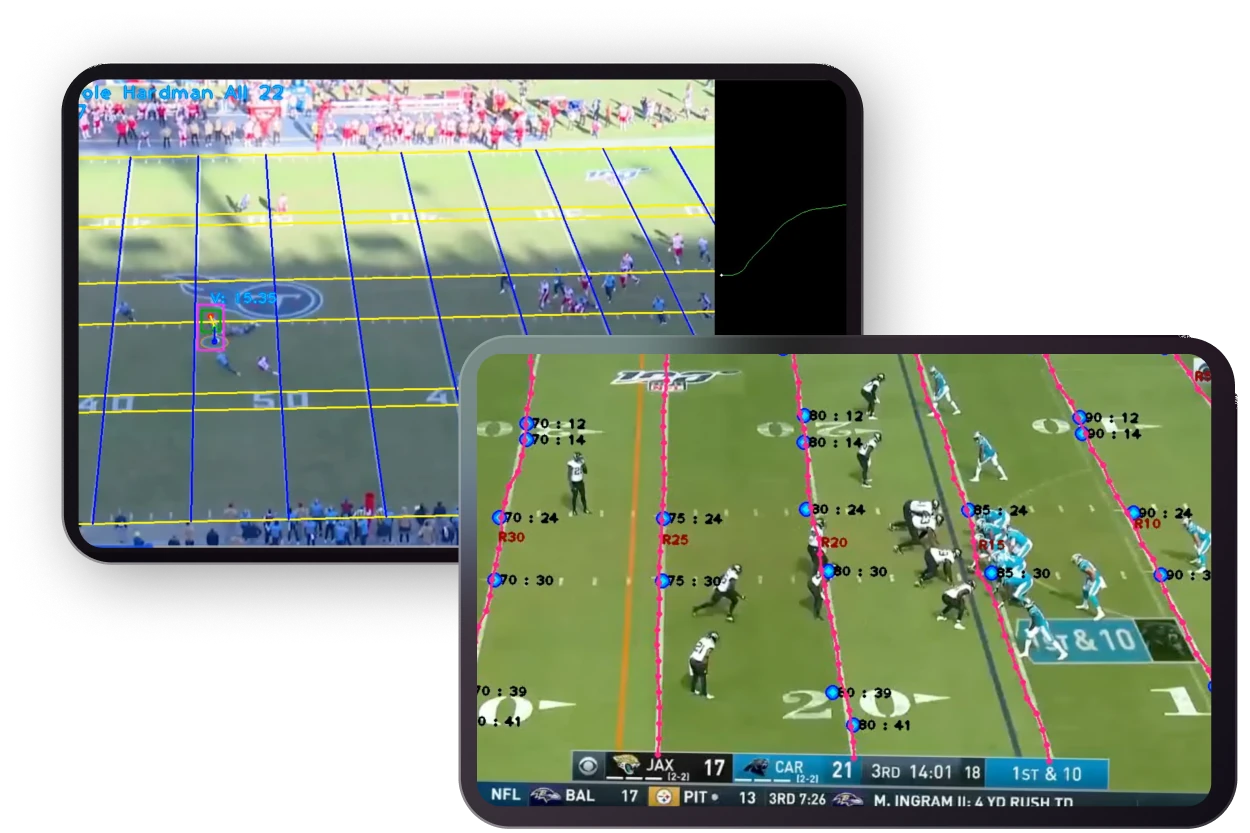
AI-Powered Football Player Performance Analysis
Part Affinity Fields (PAFs) implementation
For accurate HPE, it is necessary to determine the connections between different parts of the body and group the points. For this purpose, Part Affinity Fields (PAFs) are created using bottom-up approaches. These vector fields show the direction and connection between key body points (for example, from the knee to the elbow).
Points grouping and post-processing
At this stage, the points and their connections have already been predicted. Now, it is necessary to group the points into skeletons of individual people. Then, as a rule, post-processing follows to improve the accuracy of the data.
For example, NMS (non-maximum suppression) uses smoothing or correction methods for images. You can use temporal smoothing to improve the video so that the data is most accurate.
The Most Popular Libraries For Human Pose Estimation
Open-source libraries implement and support human pose detection. We will look at some popular libraries, each with unique advantages.

OpenPose
OpenPose is one of the first libraries intended for real-time multi-person pose estimation. It uses a bottom-up approach and helps easily identify key points in the body, hand, and face. This library is applied widely in motion capture, rehabilitation, and sports performance analysis.
PoseDetection
PoseDetection is JavaScript-based library for real-time pose estimation in the browser and on mobile devices. It supports multiple models including MoveNet, PoseNet, and BlazePose, making it a practical choice for lightweight client-side applications.
DensePose
This library is built on top of Detectron 2, which Facebook AI developed. DensePose is a vital tool for estimating poses. It helps map 2D image pixels onto a 3D surface of the body. DensePose is best used for AR and VR applications. The library is suitable for virtual try-on systems of clothes or human modeling in 3D environments.
AlphaPose
The library is known for providing high accuracy in a top-down approach in HPE. It is important, especially in crowded scenes. AlphaPose works well for pose tracking in videos. It is also used in surveillance systems and behavior recognition in smart environments.
HRNet
HRNet (High-Resolution Net) is another library in our list maintains high-resolution features throughout the network. HRNet offers accurate joint localization and is widely used in sports analysis, robotics, and medical applications.
How to Train a Pose Estimation Model
Training a model to estimate human pose is important when a neural network learns to recognize key body points in images. Below, we will consider how the training process itself occurs.

Step 1. Selecting the model architecture
It is the very first step. The most popular architecture models are HRNet, ResNet + Deconv head, and lightweight models like MobileNet. The built-in architecture determines how the model will process the image and which features will be extracted to predict key points.
Step 2. Conducting data preparation
For training, you need a large set of labeled images. Each part of the body is marked with dots. Popular datasets include COCO (Common Objects in Context), MPII Human Pose, and AI Challenger. PoseTrack is a good dataset for recognizing dots on video. This data comes in JSON or XML formats, which indicate the coordinates of each point.
Step 3. Choosing a training method
There are two main ways to teach a model to detect a pose:
-
Heatmap-based: The model predicts a heat map for each key point. The center of brightness indicates where, for example, the elbow or knee is. It is the most popular and stable approach.
-
Regression-based: The model directly predicts the key points' coordinates (x, y). The method is simpler but usually less accurate.
Step 4. Training the pose estimation model
The model is trained using backpropagation and optimizers like Adam or SGD. The result is a neural network that can output the coordinates of all key points of the body from an image. During training, the model compares its predictions with the correct answers from the dataset, improving its accuracy.
Step 5. Augmenting data
It is vital to use augmentations (artificial modifications) to prevent the model from retraining and to work with different images. These augmentations help the model generalize new data better. Examples are rotations, scaling, cropping, or mirroring.
Step 6. Evaluating and validating
After training, the HPE model is tested on another set of images. The main metric is mAP (mean Average Precision). It shows how accurately the model predicts the location of body points.
Additional information:
- The model can be fine-tuned on its own data.
- Frameworks that will help fine-tune: PyTorch, TensorFlow, MMPose, Detectron2, etc.
Real-World Applications of Pose Estimation
Human pose estimation will improve various sectors of our lives, enabling realistic virtual try-ons, enhancing athletes' performance, and more. Let's consider how HPE models change diverse fields.
AI fitness and training applications
HPE models can track body movements instantly and provide data immediately. These systems help determine the positions and angles of joints during human physical activity. Improving the results of both athletes and people who train for themselves at home is important.
Human pose estimation models also help prevent various injuries. For example, a coach may see something wrong with posture and give tips to correct it immediately.
At Requestum, we know how to develop effective human pose estimation models for sports. One of our projects is an HPE system that helps evaluate football players' performance. The solution helps coaches and players get valuable information on how to improve in-game strategies. Our system provides data with top accuracy, analyzing even frames where just a few key points are visible.

We also created an effective web app for home workouts that evaluates human movements in real-time. Users get immediate feedback on their performance during exercises and can correct their posture and actions accordingly.
For this pose estimation computer vision project, we used MediaPipe Pose for HPE, a machine-learning pipeline that works best with single-person detection. We also applied the Dynamic Time Warping (DTW) algorithm to compare the user pose to the template pose sequence.
Rehabilitation and physiotherapy applications
These applications are two very interesting directions for the development of HPE. For example, this technology helps therapists see the healing process in rehabilitation. Doctors can track how quickly a body part returns to normal by comparing ideal indicators with deviations from them due to injury or illness.
We all know that a person's posture can determine their psychological state. Our bodies can't hide stress, tension, or internal conflict. Thus, HPE technology can be very useful for experts who want to adjust the course of psychotherapeutic sessions.
One great example of applying HPE in rehabilitation is the Motion Coach by Kaia Health. It is an application that offers training plans for chronic back pain and different musculoskeletal conditions. The app uses HPE technology to monitor patients' poses and movements during therapeutic exercises.
Virtual shopping applications
Online shopping apps help customers try on clothes right from home. These applications also require a pose estimation model.
First, a 3D model of the user's body is created. Then, the clothes are virtually put on this model, taking into account the body shape and its position. Thus, shoppers can try on clothes and get size recommendations.
Some services allow customers to create a personal avatar. This avatar is like a mannequin with individual body parameters. It can repeat human movements, so buyers can estimate how the clothes will look when walking or bending.
Companies like Amazon and ZARA already use HPE technologies (mirrors with AR fitting). Another interesting example is the Zozofit project. This solution helps measure the customer's body and transmits this data to the application.
Animation and gaming applications
HPE algorithms can analyze human body movements in real-time and transform them into animation. As a result, games and animations become more interactive and lifelike.
In AR and VR games, the player can move, and their character will repeat their movements. For example, you raise your hand, and the character will do the same. Wave your hand and activate some action in the game.
Pose recognition technologies allow the creation of virtual avatars that accurately repeat facial expressions and body movements. It is especially important for streamers and VTubers and for developing characters in the metaverse. Everything a person does will be transmitted to an avatar in real-time.
Below is a screenshot of the NVIDIA Broadcast Tracker. It is free downloadable content (DLC) for VTube Studio, offering enhanced facial recognition capabilities. The project is designed for streamers and VTubers who use 2D and 3D avatars for their streams.

Surveillance and human activity tracking apps
HPE systems help anticipate strange or suspicious behavior quickly. Posture assessment technologies help monitor a person's actions in real-time, allowing security services to take appropriate action instantly.
Where are HPE models used?
-
Suspicious movements in public places. The system can notice if someone is behaving strangely or dangerously.
-
Tracking people in nursing homes. If an older adult falls, the system immediately records this and helps to react in time.
-
Control over crowd behavior. The anxiety is only setting in, but the system sees it without waiting for the situation to escalate.
-
Maintaining a safe workplace environment. HPE tracks people's movement in dangerous places, such as a construction site.
-
Smart homes have systems. They monitor people's behavior and movements. This technology will signal if someone has not moved for a long time.
-
Monitoring prisoners. In China, some detention places are already beginning to integrate advanced HPE systems.
Let’s build a solution tailored to your needs
Where Human Pose Estimation Is Headed
Standard cameras already handle what used to require motion-capture suits and controlled environments. The next wave of development is about moving deeper into everyday contexts: places where dedicated hardware isn't an option.
In sports, the focus is shifting from post-game analysis to real-time coaching: systems that flag technique errors during a drill, not after the session. In rehabilitation, the goal is remote monitoring, giving therapists objective movement data from patients at home. In AR and VR, pose estimation drives avatar control without wearables, which matters especially for consumer applications at scale.
Robotics is another frontier. Machines that can read human posture respond better in shared spaces: a logistics warehouse, a hospital corridor, a construction site. And in assisted living, fall detection and activity monitoring based on HPE are already moving from pilot programs into deployment.
The common thread: less specialized hardware, more inference on standard devices. The accuracy gains of the last three years came largely from better model architectures. The next three will come from making those models run efficiently on edge hardware: phones, embedded cameras, IoT sensors
Conclusion
In this article, you examined pose estimation models, when it is better to use 2D models, and when 3D ones are more suitable. You understood how to train such models and discovered the HPE process itself. Also, you saw examples of HPE projects and their benefits.
We considered how widely posture assessment technology is used in different industries. HPE models are used in the fashion, security, and gaming sectors. In sports, rehabilitation, and healthcare, such models are simply irreplaceable. The precise movement analysis helps improve technique, reduce the risk of injury, and build personalized training programs.
Three years ago, running accurate pose inference in real time required server-grade hardware. Today the same results are achievable on a mobile device with an on-device model and an edge-optimized runtime. The barrier to entry has dropped significantly, which means the window to build something meaningful with this technology is now.
Want to build a human pose estimation system? We at Requestum have the relevant experience to help you implement 2D or 3D human pose estimation models. Get in touch.

Our team is dedicated to delivering high-quality services and achieving results that exceed clients' expectations. Let’s discuss how we can help your business succeed.


SHARE: